Oncidium flexuoso
Người đăng:
Orchid
bela especie do sul de minas
Cattleya Walkeriana R$40.00
Cattleya Nobillor R$45.00
Mesquitae R$40.00
Oncidium R$35.00
Dendrobium R$45.00
Encyclia R$29.00
Catasetum R$40.00
Cyrtopodium R$55.00
Amalie R$70.00
Lodigesii R$ 72.00 comum R$130.00 alba(branca)
CONTATO:62 41030261 OU 62 84136689


|
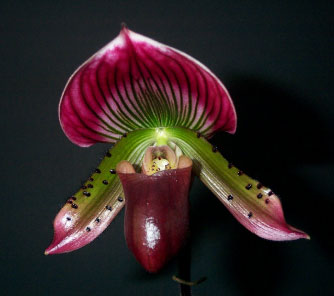
| HOW TO GROW TROPICAL SLIPPER ORCHIDS Among the most rewarding orchids for the beginner to grow in the home are the Maudiae type Paphiopedilums (paff-ee-oh-ped-ilum). The waxy pouched flowers, mostly in shades of green, white, tan, and burgundy, are held above the foliage on tall stems, and last from four to eight weeks. Larger multi-growth plants will often bloom more than once a year, yet remain relatively compact. Our guide is applicable to most tropical paphiopedilums including multiflorals (plants that produce several blooms to spike). |
WATER These plants like to be kept moist, but not wet. However, do not allow them to dry out. Test for dryness by inserting your finger about an inch into the potting medium; wait until it feels only slightly moist before watering again. Water plants thoroughly early in the day, so that the leaves are dry by nightfall. Filtered tap water, or rain water, is best. Water should be tepid, not cold. Watering schedules will vary considerably depending on light and temperature conditions. Plants may dry out rapidly in warm dry conditions, needing water every few days, or may remain moist in cooler seasons for longer periods of time. Water your plant according to its need, not your schedule.
| LIGHT Most paphs are low-light plants, and like a shady spot where they receive bright indirect light. They will do fine in eastern, or shaded western or southern exposures. As a rule, do not place mottled-leafed plants in direct sunlight. Let the foliage be your guide: leaves should be medium green in color with darker well-defined patterns in the mottled leaf types. Many of the larger multifloral paphs, usually with plain green foliage, need considerably brighter light to bloom, especially during the winter months. |
|
TEMPERATURE AND VENTILATION Most paphs are happy with intermediate to warm temperatures from 75-80 during the day, and around 65-70 at night. A drop in temperature at night during the cooler months, may help induce buds. ‘Standard’ or 'complex' paphs enjoy temperatures about 5 degrees cooler. Make sure that there is always adequate ventilation and air circulation, particularly in the winter, or during very humid conditions, in order to avoid fungal and bacterial disease. However, do not subject plants to blasts of cold or hot air. An oscillating fan that moves air constantly at low speed is extremely beneficial.
| Oncidium | |||||||||
|---|---|---|---|---|---|---|---|---|---|
 Oncidium incurvum | |||||||||
| | |||||||||
| Species | |||||||||
| See text. | |||||||||
| Synonyms | |||||||||
|
Oncidium, abbreviated as Onc in horticultural trade, is a genus that contains about 330 species of orchids from the subfamily Epidendroideae of the orchid family (Orchidaceae). This is a complex, difficult genus, with many species being reclassified. Calls are made for splitting this genus into multiple genera.
Contents[hide] |
This genus was first described by Olof Swartz in 1800 with the orchid Oncidium altissimum, which has become the type species. Its name is derived from the Greek word "onkos", meaning "swelling". This refers to the callus at the lower lip.
Most species in the Oncidium genus are epiphytes, although some are lithophytes or terrestrials. They are widespread from northern Mexico, the Caribbean, some parts of South Florida to South-America. They usually occur in seasonally dry areas.
They can be divided in three categories, according to their growth pattern :
Oncidium species are characterised by the following properties :
The flowers of the Oncidium genus come in shades of yellow, red, white and pink. The petals are often ruffled on the edges, as is the lip. The lip is enormous, partially blocking the small petals and sepals.
Some Oncidium orchids are very long : Oncidum altissimum and Oncidium baueri can grow to a height of 5 m, while Oncidum sarcodes can reach 3 m.
They are known as 'spray orchids' among some florists. They are very varied and are easily hybridised with Odontoglossum. Together with other closely related genera (Cochlioda, Miltonia, Cuitlauzina, Miltoniopsis, Osmoglossum, Leochilus, Comparettia, Cyrtochilum, Odontoglossum, Tolumnia, Rhynchostele [formerly Lemboglossum], Psychopsis, etc.) they form the Oncidium alliance. Some of the best Oncidium alliance hybrids originate from Oncidium tigrinum and Oncidium incurvum, when crossed with Odontoglossums, although hybridization possibilities of this group of orchids are literally endless, and there are literally hundreds of thousands of excellent hybrids in the Oncidium alliance.